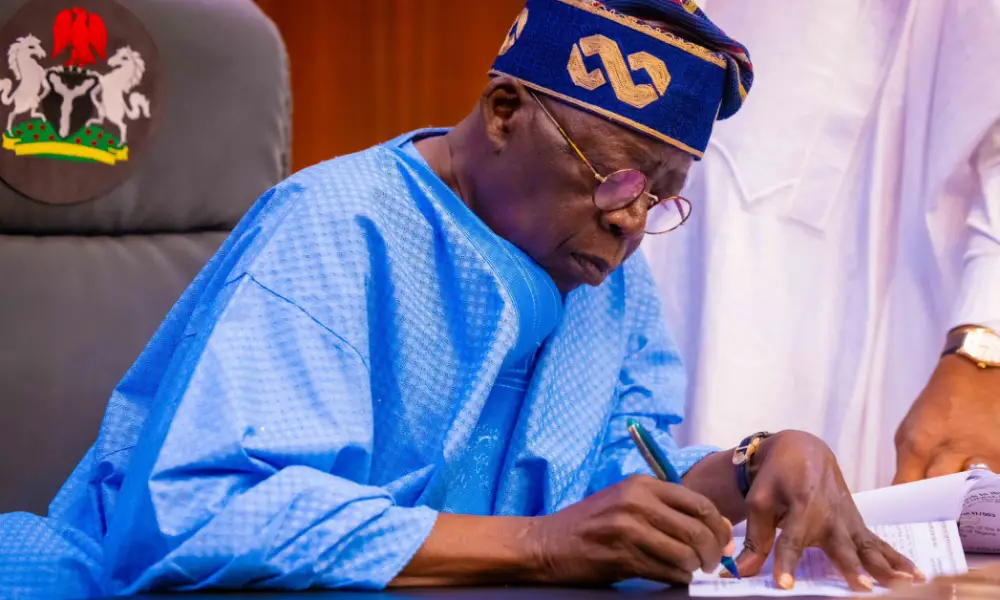
President Bola Ahmed Tinubu signed four Executive Orders on July 6, 2023, to carry on his promise to address business-unfriendly fiscal policy measures and the proliferation of taxes. The Orders include:
The Finance Act (Effective Date Variation) Order, 2023, which has now deferred the commencement date of the changes contained in the Act from May 28, 2023, to September 1, 2023.
The Customs, Excise Tariff (Variation) Amendment Order, 2023, which shifts the commencement date of the tax changes from March 27, 2023, to August 1, 2023.
An Order suspending the 5% Excise Tax on telecommunication services as well as the Excise Duties escalation on locally manufactured products.
An Order suspending the newly introduced Green Tax by way of Excise Tax on Single-Use Plastics (SUPs), including plastic containers and bottles as well as the suspension of Import Tax Adjustment levy on certain categories of vehicles.
Both the Finance Act Order 2023 and the Customs, Excise Tariff Order 2023 were signed as an attempt by the Government to address several fiscal policies and issues. Such as to ensure that the 2017 National Tax Policy’s requirement for a minimum of ninety (90) days’ advance notification for tax adjustments is adhered to which is global practice. This will allow businesses and taxpayers reasonable time to get acquainted with the new tax regime.
In total, four (4) Finance Acts have been passed – Finance Acts of 2019, 2020, 2021, and the resent one signed on the 28th of May 2023, just a day before the end of his tenure, with an effective date of 1 May 2023. On all three occasions there have been several changes to tax law and several tax policies were being applied retroactively, with commencement dates that, in some cases, predate the formal release of the supporting legal instrument. This can be evidenced in the case of Accugas Limited vs FIRS & 1 Or (2022). In the aforementioned case, the question that needed to be answered by the court was whether the provisions of the Finance Act, 2019 (FA 2019) can be applied retroactively to periods, transactions, activities, and income earned prior to 13 January 2020, when the Finance Act was assented to (in light of the provisions of sections 6(1)(b) and (c) of the Interpretation Act). The Court held that it is established that the law that applies to a cause of action is the law in force when the cause of action arose. In the case of Accugas, the applicable law for taxing its income earned between January 2019 and December 2019, is the law in force as of 31 December 2019. The Court further established that while certain laws may be made to apply retrospectively, such retroactive application must be expressly stated in the enactment of the law. Nevertheless, because the Finance Act Order 2023 and the Customs, Excise Tariff Order 2023 failed to provide the required amount of time for notice, companies were in violation of the new tax regime even before the adjustments were gazetted.
The current situation regarding the five percent (5%) Excise Tax on telecommunication services is lacking in clarity in terms of its practicability, necessity and its application. The 5% Excise Tax was imposed in the approved Nigeria’s 2023 Fiscal Policy Measures (FPM) by the previous Buhari administration who also later removed the excise duty for telecom sub-sector of the Nigeria’s Digital Economy in March of this year following the recommendations of the Presidential Review Committee on Excise Duty in the Digital Economy Sector specifically on the bases that forty-one (41) categories of taxes, levies and charges are already in the digital economy sector, hence there is no justification for an additional excise. Thus, this new order may seem redundant. Also, the proposed increase in Excise Tax on tobacco products and alcoholic beverages from 2022 to 2024, as outlined in the 2022 Fiscal Policy Statement (stating that the excise duty on beer and stout will start at N75 per liter in 2023 and will be raised to N100 per liter in 2024), is already being implemented. Therefore, introducing further escalation in the approved rates would create a perception of policy inconsistency and generate an atmosphere of uncertainty for businesses operating in Nigeria. Given these circumstances, it becomes crucial to issue an order suspending the 5% excise tax on telecommunication services which is aimed at reducing the rising price of telecom bills paid by consumers and halting the proposed escalation of excise taxes on locally manufactured products. This action aims to address the potential negative consequences associated with policy inconsistencies and uncertainty for businesses. By signing the suspension order, the government hopes to promote a more stable and predictable environment for businesses operating in Nigeria.
The recently implemented Green Tax, specifically the Excise Tax on Single-Use Plastics (SUPs), which included plastic containers and bottles at a rate of 10%, along with the Import Tax Adjustment levy on certain vehicles (I.e., the 2% on imported motor vehicles of 2000cc to 3999 and 4% on 4000 cc engine capacity), has now been suspended by the president. This decision was made to allow for further consultation within a comprehensive fiscal policy framework and to adopt a holistic approach to the country’s net-zero plan. The objective is to ensure that these tax measures do not have a negative impact on the country’s economy. By suspending these taxes especially in light of the effects of the removal of the fuel subsidy, it was envisaged that it would undoubtedly boost efforts toward improving the operating environment and reduce the high cost of doing business in Nigeria. The suspension is also focused at creating a conducive environment for discussions and analysis that will enable the development of effective and sustainable policies in line with the country’s economic goals.
CONCLUSION
There are currently over fifty separate taxes and other charges that must be paid by businesses, making the issue of tax multiplicity grow to be a significant concern for companies and businesses in the whole country. Therefore, this Orders are expected to ensure that Nigerian businesses or individuals are freed from unnecessary burdens of tax payments, the Orders are expected to help curb the growth in inflation, and boost productivity in the workplaces. The question now is “are these Executive Orders enough to actually address the cost of doing business and the cost of living in the country?”
These Orders according to the Special Adviser to the President on Special Duties, Communications and Strategy, Mr. Dele Alake, are focused on lightening tax burdens, harmonizing our taxes, managing already existing taxes in the best interest of Nigerians and are aimed to ameliorate the negative impacts of the tax adjustments on businesses and the chokehold on households across affected sectors.
-WRITTEN BY ONYINYE IGBOANUZUE FROM A&E LAW PARTNERSHIP, ABUJA.